Professional Confidence and Presence for Real Estate Professionals
A practical guide to communicating with clarity, calm, and professional authority—especially for real estate students and new agents.
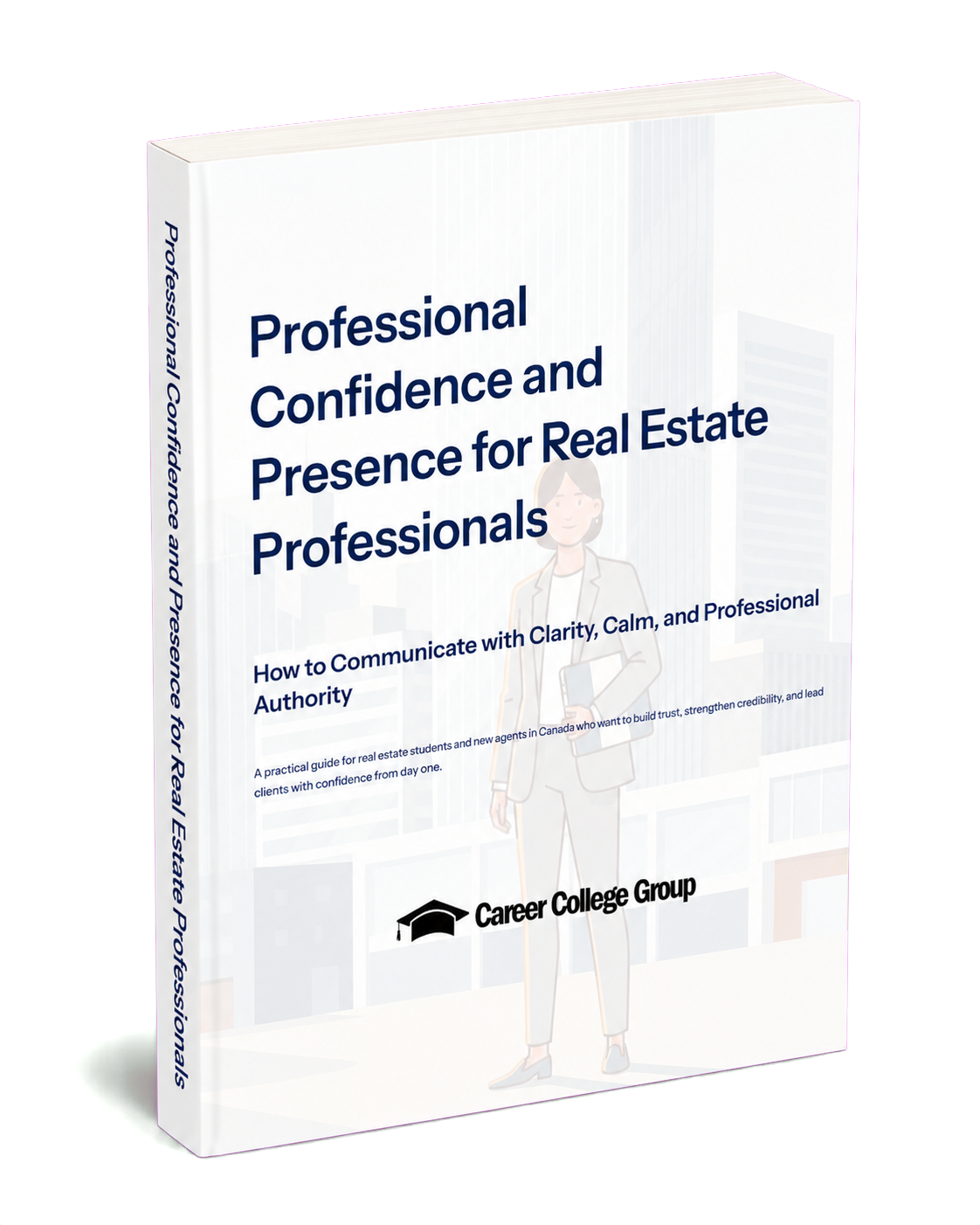
Download the Complete Ebook as a PDF
Download the professionally formatted edition for offline reading, printing, or saving with your notes.
Explore the Guide
Jump directly to any chapter, or begin with the introduction and read the ebook from start to finish.
Build Trust Before Experience Is Fully Visible
This free guide is designed for real estate students and newer agents who want to communicate more confidently with clients. It explains how professional presence, clear recommendations, body language, meeting structure, and preparation can strengthen credibility from the beginning of a career.
How can a new real estate agent sound more confident?
Preparation, clear recommendations, calmer pacing, and visible next steps help newer agents project professional authority without pretending to know everything.
Does confidence mean being forceful?
No. Professional confidence is calm, clear, and directional. It gives clients guidance while leaving room for questions and decisions.
How does body language affect client trust?
Posture, eye contact, stillness, pace, and purposeful movement reinforce—or weaken—the credibility of what an agent is saying.
What is one simple way to reduce verbal hesitation?
Replace filler phrases with a short pause, then use a structured statement such as “Based on what we know, I recommend…”
Why Confidence and Presence Matter Early in a Real Estate Career
In real estate, knowledge matters. Yet technical knowledge alone is not what causes clients to trust a professional. Trust is also influenced by tone of voice, the ability to remain calm, the way recommendations are framed, and whether a client feels guided rather than unsettled.
For students and agents who are just beginning their careers, this can feel intimidating. Many assume they must wait years before they can sound confident or be taken seriously. In reality, confidence is built through habits that can be practiced early: clearer language, thorough preparation, greater steadiness, and communication that helps clients feel safe and informed.
This guide is not about sounding overly polished, rehearsed, forceful, or dominant. It is about communicating with clarity, calm, and professional authority - becoming the kind of professional who can guide a conversation, structure a meeting, and support a client decision without sounding hesitant or heavy-handed.
Confidence Shapes Experience
Confidence influences how clients experience your advice.
Presence Builds Trust
Presence shapes trust before expertise is fully visible.
Habits Start Early
Strong professional habits can be built early in a real estate career.
Building Trust Through Presence
Trust in real estate is often built in the smallest moments. Before clients fully understand your qualifications, market knowledge, or negotiation skills, they are already forming impressions.
They notice whether you seem calm or rushed. They notice whether your recommendations sound clear or uncertain. They notice whether you appear grounded enough to guide them through an important decision.
Real estate decisions are rarely neutral. Buyers and sellers may be worried about timing, money, family needs, competition, or the emotional weight of a major transition. They are not simply looking for information. They are looking for reassurance and a professional who can lead them through uncertainty with clarity and good judgment.
Clients are silently asking
- Do you feel in control?
- Can I trust your judgment?
- Will you guide me when this becomes stressful?
Calm, directional language
- Let me walk you through my recommendation.
- Here is how I would approach this.
- Here is what I believe will position you best.
- Let's focus on what matters most in this situation.
Key Takeaways
- Clients form impressions quickly, especially in high-stakes situations.
- Presence often shapes trust before expertise is fully understood.
- Small habits in tone, pace, and delivery make a meaningful professional difference.
Confidence Without Arrogance
Many thoughtful professionals hesitate to sound confident because they worry about appearing pushy, dismissive, or overly certain. Confidence and arrogance, however, create very different experiences.
Confidence
Confidence is calm and clear. It offers direction without pressure, explains reasoning without overwhelming the client, and leaves room for dialogue.
Arrogance
Arrogance feels heavy. It talks over the client, dismisses concerns too quickly, or tries to dominate the conversation rather than guide it.
Clients do not need an agent who sounds forceful. They need an agent who sounds steady. The most trusted professionals are often those who make others feel safe, not small. You do not need to choose between being respectful and being authoritative. You can be both.
Language that projects confidence without pressure
Key Takeaways
- Confidence is not force. It is clarity, calm, and direction.
- Clients respond well to professionals who guide without overpowering.
- Respect and authority can work together in the same conversation.
Speaking with Certainty
One of the most practical ways to strengthen professional presence is to improve how recommendations are framed.
Many people sound uncertain not because they lack knowledge, but because their language feels tentative or unstructured. When advice sounds vague, hesitant, or apologetic, it creates hesitation on the other side. When advice sounds organized and grounded, clients are more likely to relax and listen.
Certainty is not pretending to know everything. It is showing that your recommendation is based on something real. Explain what you are basing your advice on, what you recommend, and why. The structure itself creates authority.
Based on ___, I recommend ___ because ___.
Statement examples
Replace weaker phrases with stronger structure
Key Takeaways
- Strong recommendations sound grounded, not dramatic.
- Structure helps clients trust your reasoning.
- Clear phrasing creates authority without overpromising results.
Eliminating Filler Language and Verbal Hesitation
Even when the advice itself is strong, the delivery can weaken it. This often happens through filler language.
Words such as “just,” “hopefully,” “kind of,” and “I think” can slip into speech because people want to sound polite, cautious, or conversational. In a client interaction, these habits can make the speaker sound less certain, less structured, and less professional than they really are.
Real estate clients are highly sensitive to uncertainty. They may not consciously identify every phrase that weakens a message, but they notice the effect. Cleaner, more direct language makes the conversation feel more stable.
Many people rush to fill pauses because silence feels awkward. In professional settings, a pause creates space to think, allows the listener to absorb the message, and makes the speaker sound more deliberate and composed.
Cleaner replacements to practice
- What I recommend is…
- Our plan is…
- In short…
- Here is the takeaway…
- The trade-off is…
- If I were advising my own family, I would…
Simple shifts that improve credibility
- Remove “just” when it adds nothing.
- Replace “hopefully” with a clear plan.
- Replace “kind of” with a pause and a complete sentence.
- Replace “I think” with reasoning that supports the recommendation.
Key Takeaways
- Filler words weaken otherwise strong advice.
- Pauses make communication sound more thoughtful and composed.
- Cleaner speech leads to stronger professional presence.
Body Language That Supports Credibility
Clients do not only listen to your words. They read your body language as well.
Posture, eye contact, hand movement, pace, and overall stillness all contribute to how professional and confident you appear. Grounded body language communicates calm leadership: upright posture suggests readiness, still hands suggest control, measured movement suggests composure, and comfortable eye contact suggests engagement.
Physical restlessness can undermine credibility. Fidgeting, rushing through a space, trailing off at the end of sentences, keeping a phone in hand, or constantly moving without purpose may create an impression of uncertainty. The goal is not to imitate someone else's style. It is to become more grounded.
Upright Posture
Suggests readiness and calm leadership before a word is spoken.
Eye Contact
Comfortable eye contact signals engagement and builds connection.
Still Hands
Measured hand movement suggests composure and control.
Measured Movement
Moving with purpose rather than rushing communicates steadiness.
Language anchors that support calm delivery
Key Takeaways
- Clients notice physical signals quickly.
- Calm body language reinforces verbal confidence.
- Grounded posture and measured movement strengthen credibility.
Leading Meetings and Property Showings with Calm Structure
Meetings and property showings are opportunities to make professional presence visible. In both settings, structure plays a major role.
In meetings, strong presence often begins with an agenda. Explain how the meeting will go, walk through the reasoning behind a recommendation, and summarize next steps aloud. This creates a sense of calm authority, especially when discussing pricing, timing, or strategy.
Property showings require a quieter kind of presence. A strong agent does not need to fill every room with commentary. Guide clients through the space, speak selectively, and pause at key moments. Buyers need time to observe, compare, and imagine.
Meeting phrases
- Here is how today's meeting will go.
- Let me walk you through my recommendation.
- In short, the best option is ___ because ___.
- The next step from here is ___, and I will handle ___.
Showing phrases
- This is usually the room buyers focus on most.
- Here is what stands out about this space.
- What matters here is ___.
- At the end, I will summarize how this compares with the others.
Key Takeaways
- Meetings improve when structure is visible and verbal.
- Showings benefit from calm guidance rather than constant talking.
- Clients feel more supported when the professional leads clearly.
Establishing Credibility as a New Agent
Clients are not hiring only your past. They are hiring your leadership in the present.
When you come into a meeting with a plan, clear next steps, relevant information, and a structured approach, you immediately strengthen your position. Preparation reduces hesitation because you are not inventing your process in real time.
Do not weaken yourself unnecessarily with phrases such as “I'm new, but…” Speak from process rather than apology. You do not need to pretend to know everything. You do need to show that you know how to approach the situation responsibly.
Clients respect honesty when it is paired with ownership. When asked something you do not yet know, explain what you know so far, what you will confirm, and when you will return with an answer.
Useful phrases for newer agents
Key Takeaways
- New agents can sound credible without pretending to know everything.
- Responsibility sounds confident; bluffing sounds risky.
- Preparation is one of the fastest ways to strengthen presence.
Daily Practices That Strengthen Professional Presence
Professional confidence is not built in a single breakthrough moment. It is built in repetition.
Cleaner language, calmer delivery, stronger structure, and grounded body language may seem like small adjustments, but together they create a noticeable shift. Confidence should be understood as a skill rather than a personality trait.
You do not need to change everything at once. Lasting growth usually comes from choosing a few behaviours and practicing them intentionally. What feels deliberate at first eventually becomes natural. You do not need to wait until you “feel confident” before you act professionally. You act with professionalism first, and confidence grows as a result.
Daily anchors to practice
- Here is the plan.
- Here is what happens next.
- Here is what I will be watching for you.
- Let me answer that clearly.
- The key takeaway is this…
Choose three habits to practice consistently
- Pause before responding.
- Slow your speech slightly.
- Stand when presenting strategy or pricing.
- Lead with an agenda.
- Keep your hands visible and distractions away.
- Summarize next steps out loud.
Key Takeaways
- Confidence is built through repeated professional behaviour.
- Small habits create visible improvements over time.
- You do not need instant transformation; you need steady practice.
Calm Creates Trust
Professional confidence is not about pretending to be someone you are not. It is preparation combined with clear execution.
Clients remember how a professional made them feel. They remember whether they felt reassured or unsettled, guided or confused, respected or pressured. Those impressions influence trust, and trust influences decisions.
For students and new agents, the most encouraging truth is that these skills can be developed now. Strengthen your language, simplify your recommendations, reduce filler words, improve your body language, and lead with more structure.
Speak Clearly
Speak clearly and with structure.
Prepare Well
Let preparation support your confidence.
Stay Grounded
Use calm language and grounded body language to build trust.
Build Habits
Practice steady habits until they become part of your professional identity.
Download the Complete PDF Edition
Download the professionally formatted PDF for offline reading, printing, or future reference.
Download the Free PDF
Sameer Amini
Sameer Amini is Career College Group’s Lead Facilitator and an experienced real estate operations and education professional. Over more than 12 years in the industry, he has worked across brokerage management, compliance, agent development, residential and commercial real estate, and luxury brokerage operations.
His leadership experience includes serving as a Broker of Record and Director of Operations, developing training and compliance systems, and mentoring agents, teams, and brokerage owners. He also spent nearly five years facilitating and supporting learners and educators at Humber College before continuing that work with Career College Group.
Sameer’s teaching combines practical industry knowledge with a strong focus on mentorship, professional judgment, and the skills learners need to move confidently from coursework into the field.