Is Real Estate the Right Career for You?
A Practical Guide to the Opportunities, Challenges, and Education Pathway in Ontario
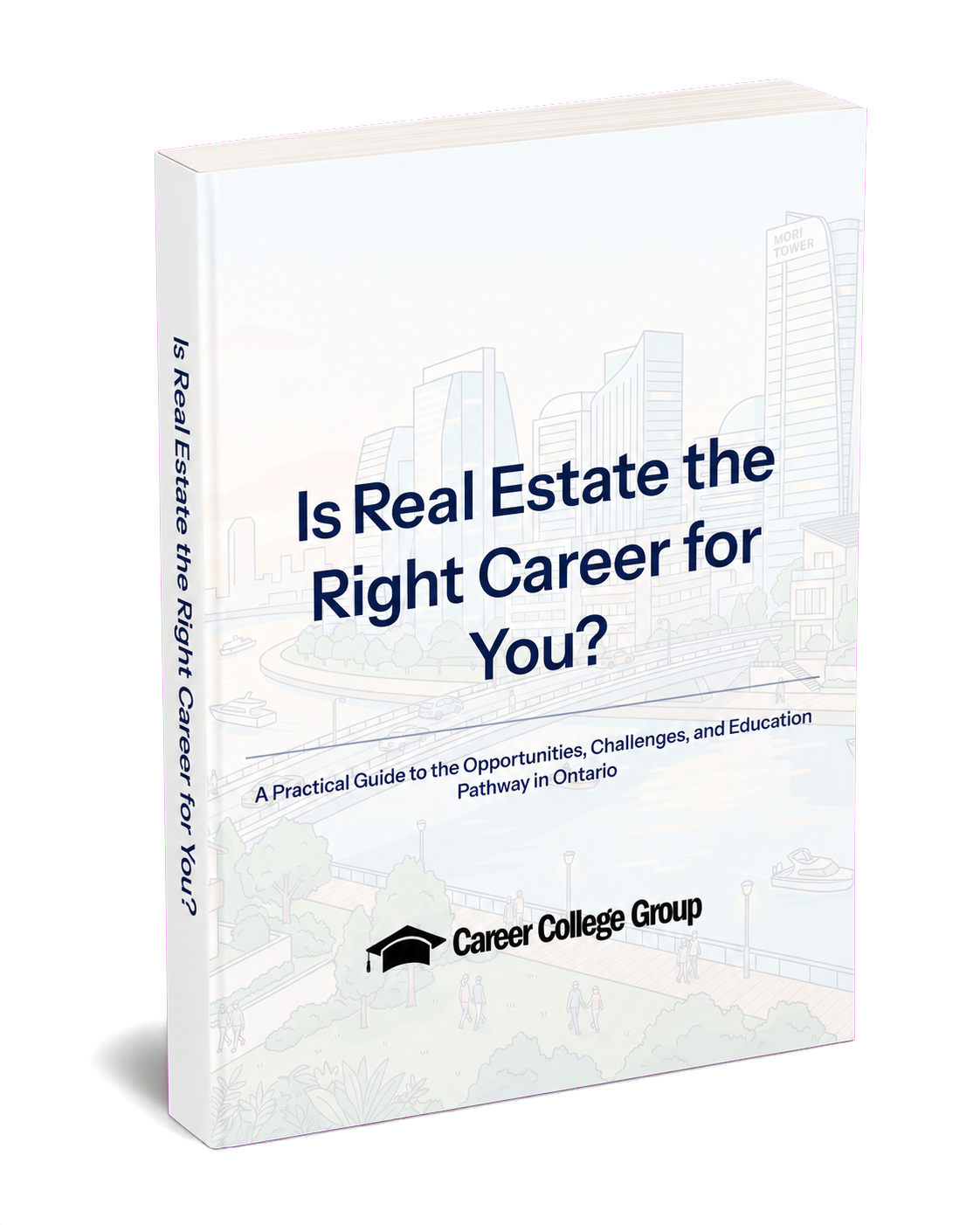
Download the Complete Ebook as a PDF
Download the professionally formatted edition for offline reading, printing, or saving with your notes.
Explore the Guide
Jump directly to any major section, or begin at the introduction and read the guide from start to finish.
This Guide Is Here to Help You Decide
This guide is designed to help prospective learners make an informed decision about whether a real estate career aligns with their strengths, expectations, and long-term goals. It explains what the work actually involves, where the opportunities are, what challenges to expect, and how the Ontario education pathway works.
Rather than romanticizing the profession, the guide offers a realistic view of both the independence and the responsibility that come with real estate. It is especially helpful for people who are exploring the field for the first time and want a clearer picture before they commit.
This Guide Is Here to Help You Decide
Real estate can be an exciting career path. It offers flexibility, independence, income potential, and the chance to help people through some of the biggest decisions of their lives. But real estate is also often misunderstood.
If you are considering real estate, you may like the idea of building your own business, setting your own schedule, working with people, or creating income based on your own effort. Those opportunities are real. But they are only one side of the story.
Real estate is a people-focused career built on trust, service, preparation, and follow-through. It can be rewarding, but it also requires consistency, patience, and a willingness to keep learning. This guide is not here to pressure you. It is here to help you make a clear decision.
Key Takeaway
Real estate can be a powerful career path, but it works best when you understand both the opportunity and the responsibility.Is This Career the Right Fit for You?
The question is not only, “Can I become a real estate agent?” The deeper question is whether the work fits the way you want to live, communicate, and build your future.
Real Estate May Be a Strong Fit If You...
- Enjoy working with people
- Can manage your own time
- Are comfortable with uncertainty
- Are willing to take responsibility for your own progress
It May Be More Challenging If You...
- Need immediate predictable income
- Prefer routine work
- Dislike networking
- Struggle without daily direction
Ask Yourself
Real Estate Is More Than Showing Homes
From the outside, real estate can look simple. People may see agents walking through homes, posting listings, or celebrating closing day. That is only a small part of the work.
Behind every transaction is research, paperwork, communication, negotiation, scheduling, emotional support, and problem-solving.
What People See
Home showings, listings, closing celebrations, and commissions.
What Actually Happens
Research, paperwork, negotiation, scheduling, emotional support, and problem-solving.
The Real Role
A strong agent is not just a salesperson - a strong agent is a guide.
A Real Client Situation
Imagine a couple going through a divorce. They own a home together and may have years of memories tied to it. Now they need to sell during one of the most stressful times in their lives.
They may not know how to price the home, prepare it, market it, review offers, or avoid mistakes. The agent explains the process, coordinates the details, protects the clients' interests, and helps both parties move through the transaction with more clarity.
The Agent's Role
- Explain the selling process clearly
- Coordinate all transaction details
- Protect the clients' interests
- Help both parties reach clarity
- Manage emotional complexity professionally
Key Takeaway
Real estate is not just about property. It is about people, life events, and decisions that matter.Different Clients, Different Needs
Each client brings a different goal, timeline, budget, and emotional situation. The agent's role is to understand the client's needs, explain the options, manage the process, and help the client make informed decisions.
First-Time Buyer
Needs guidance after years of saving and is navigating the process for the first time.
Growing Family
Needs more space and the right neighbourhood for the next chapter of life.
Seller Downsizing
May be relocating or simplifying and needs a smooth, well-managed sale.
Investor
Needs market knowledge, analysis, and strategic guidance.
Business Owner
Needs commercial space that fits operational needs and long-term plans.
Before a Property Goes on the Market
A listing does not begin when the sign goes up. A successful listing is built before the public ever sees it.
Research
Market analysis and comparable sales.
Paperwork
Client forms and agreements.
Preparation
Cleaning, staging, repairs, and landscaping.
Marketing
Photography, video, and launch materials.
Before a property is listed, the agent may research the property, review comparable sales, study market conditions, and help the client choose a realistic pricing strategy. Clients need to understand what they are signing and why it matters. After that, the property may need cleaning, decluttering, staging, repairs, landscaping, photography, video, and marketing materials.
Managing the Moving Pieces
A real estate transaction can involve many people. The agent does not personally do every task, but often helps coordinate the process so the right steps happen at the right time.
Marketing, Showings, and Open Houses
Showing a property is not just about unlocking the door. It is about understanding the property, communicating clearly, responding honestly, and representing the client professionally.
Launch the Listing
Prepare marketing materials, go live on MLS, and respond to initial inquiries.
Manage Showings
Schedule property viewings, answer questions, and represent the client professionally.
Host Open Houses
Welcome prospective buyers, neighbours, and other agents while gathering feedback.
Keep the Client Informed
Report showing activity, buyer feedback, and market response while managing anxiety.
Where Strategy and Emotion Meet
Offer time can be exciting, but it can also be stressful. The agent helps the client review price, conditions, deposit, closing date, terms, and the overall strength of each offer.
What the Agent Reviews
- Offer price and deposit amount
- Conditions and contingencies
- Closing date and timeline
- Overall strength and risk of each offer
Why the Highest Price Isn't Always Best
The highest price is not always the best offer if the conditions, timing, or risks do not work for the client. Negotiation also requires emotional control because property may be a home, a major asset, or part of a family's life story.
The Work Continues After the Offer Is Accepted
Once an offer is accepted, the transaction is not over. The closing period can take weeks or months. During that time, the agent continues communicating, coordinating, and supporting the client.
Satisfy Conditions
Inspections, financing, and due diligence.
Coordinate Professionals
Lawyers, mortgage brokers, and inspectors.
Manage Closing
Paperwork, timelines, and communication.
Transaction Closes
Ownership transfers and keys are released.
The Opportunity Behind the Work
For many people, real estate offers a combination of opportunity, independence, variety, and personal fulfillment that can be hard to find in a traditional job. In many ways, real estate is like starting a business.
Build Your Reputation
Your name and track record become your most valuable asset.
Develop Relationships
Long-term client relationships drive referrals and repeat business.
Create Systems
Build processes that let you serve more clients effectively.
Grow Through Effort
Your results are tied to your own initiative and consistency.
Key Takeaway
Real estate can be exciting because you are not just taking a job. You are building something.There Is No Fixed Salary Cap
One of the major attractions of real estate is income potential. Income is typically commission-based, which means there is no fixed salary cap.
The Upside
- No fixed salary ceiling
- A single transaction can produce a meaningful paycheque
- Some agents build substantial businesses over time
- Income grows with reputation and relationships
The Reality
- Commission income is not automatic
- Agents are typically paid when transactions close
- Income depends on activity, relationships, and service
- Market conditions and brokerage arrangements matter
Flexibility Does Not Mean Easy
Real estate can offer more control over your calendar, daily tasks, and work rhythm. But clients may need evenings, weekends, or urgent responses.
What Flexibility Looks Like
Control over your calendar, daily tasks, and work rhythm - more autonomy than many traditional jobs.
What Flexibility Requires
Availability for evenings, weekends, and urgent client needs. Responsiveness is part of the job.
Key Takeaway
Real estate is not “work whenever you feel like it.” It is independence with responsibility.Helping People Through Major Decisions
Real estate can be fulfilling because the work is personal. These decisions often involve emotion, money, family, and long-term goals.
First Home Purchase
Helping someone buy their first home after years of saving.
Life Transitions
Supporting clients through divorce, relocation, downsizing, or other major changes.
Investment Growth
Helping investors make strategic decisions that support long-term goals.
What Makes Real Estate Challenging?
A balanced decision requires an honest look at the challenges. Real estate can be excellent for the right person, but it should not be entered casually.
Delayed Income
It can take time to complete training, build relationships, find clients, complete a transaction, and reach closing.
Unpredictable Schedule
Clients may need evenings, weekends, and urgent responses.
Rejection and Pressure
There will be rejection, negotiation pressure, difficult clients, and uncertain outcomes.
Ongoing Uncertainty
Market conditions, client decisions, and outcomes are never fully within the agent's control.
You Do Not Need to Be Pushy
Real estate is not about pressuring people. Clients want to feel understood, respected, and protected.
Listen Carefully
Ask good questions and truly hear what clients need before offering solutions.
Explain Options
Help clients understand their choices rather than steering them toward a quick decision.
Act With Integrity
Be honest when you do not know something and professional enough to find the answer.
Follow Up Consistently
Responsiveness and reliability build long-term trust.
Key Takeaway
You do need to be comfortable with people. But you do not need to pretend to be someone you are not.Do You Have the Right Fit?
Use these questions to reflect honestly on whether real estate aligns with your strengths, lifestyle, and goals.
People Skills
Are you comfortable speaking with people you have never met? Can you listen carefully and build trust?
Self-Management
Can you manage your time, create a plan, and follow through without daily supervision?
Financial Readiness
Can you prepare for several months without immediate commission income?
Schedule Flexibility
Are you comfortable with evenings, weekends, and changing client needs?
Learning Mindset
Are you willing to keep learning after registration through brokerage training and ongoing education?
Resilience
Can you handle rejection, pressure, and client emotions while staying professional?
What Your Self-Assessment May Tell You
Use your honest answers to understand where you stand - and what steps to take next.
If most of your answers were yes, real estate may be a strong fit for your strengths and goals. If your answers were mixed, real estate may still be possible, but you should plan carefully. You may need to build a financial cushion, improve your study habits, strengthen communication skills, or choose a more structured learning pathway. If most answers were no, pause before investing time and money.
How the Pre-Registration Path Works
In Ontario, future real estate agents complete a structured education pathway before becoming registered. Learners progress course by course rather than through a traditional semester format.
Pre-Registration Education
- Course 1 - Foundation of real estate knowledge
- Course 2 - Building on core concepts
- Course 3 - Advanced preparation
- Simulation Session 1 - Practical activities and role play
- Course 4 - Continued learning
- Simulation Session 2 - Applied real-world scenarios
- Course 5 - Final pre-registration course
After the Courses
- Apply for registration with RECO
- Join a brokerage for practical training and supervised work
- Complete required post-registration education during the first registration cycle
From Education to Registration
Completing pre-registration education is a major step, but it is not the end of learning.
Complete Pre-Registration
Courses and simulation sessions.
Apply and Register
Submit the RECO application and obtain approval.
Begin Professional Practice
Join a brokerage with training and supervision.
The brokerage stage matters. New agents need practical training, supervision, systems, and support as they begin working with real clients. During the first two years, registrants also complete additional post-registration education requirements.
Key Takeaway
The strongest agents keep learning after the classroom.Self-Paced or Cohort-Based?
Students have different learning styles. Choosing the right format matters because momentum matters.
Self-Paced Learning
May fit students who are:
- Independent and self-motivated
- Organized and disciplined
- Comfortable studying on their own
- Able to create and maintain their own schedule
Cohort-Based Learning
May fit students who want:
- Structure and scheduled sessions
- Guided review and discussion
- Accountability and peer connection
- Support from experienced professionals
Structure, Guidance, and Accountability
Career College Group offers both self-paced and cohort-based real estate education options.
Self-Paced Option
Flexibility and independence to move through the material at your own speed.
Cohort Option
Move through the program with a group, attend regular online sessions, review material, and ask questions.
Real-World Connection
Hear practical examples from experienced professionals and connect concepts to real situations.
Built-In Accountability
Know what you are working on, when you are meeting, and how you are progressing.
Key Takeaway
For many learners, support and structure can make the difference between starting and finishing.Starting Strong Means Planning Ahead
Beginning a real estate career requires investment. Review program costs, understand what is included, consider your personal budget, and prepare for both education and the early career phase.
CCG Cohort Model Includes
- Structured support and guided sessions
- Monthly payment plan option for eligible cohort students
- A more manageable pathway over time
What to Plan For
- Education and registration-related costs
- Professional fees and early business expenses
- The early months of building your client base
Common Questions From Future Real Estate Students
Do I need to be a natural salesperson?
No. Real estate is about trust, communication, knowledge, and guidance - not pressure. Many successful agents are quiet, thoughtful, and service-oriented.
Can I work while studying?
Many students do. The right approach depends on your schedule, study habits, and support needs. A cohort model can help you stay on track.
Is real estate too competitive?
It is competitive, but also relationship-based. New agents create opportunity through consistency, professionalism, responsiveness, and trust.
When do agents start earning income?
Agents are typically paid when a transaction closes. New agents should be financially prepared for the early months before consistent income arrives.
What happens after I complete the courses?
You apply for registration with RECO, join a brokerage, continue training, and complete required post-registration education.
So, Is Real Estate the Right Career for You?
Real estate can be an excellent career for the right person. It offers income potential, flexibility, independence, variety, and the opportunity to help people through major life decisions. It also requires patience, resilience, financial planning, and a willingness to keep learning.
What Real Estate Offers
- Income potential with no fixed ceiling
- Flexibility and independence
- Variety in daily work and clients
- Meaningful impact on people's lives
- The satisfaction of building your own business
What Real Estate Requires
- Patience during the early months
- Resilience through rejection and uncertainty
- Financial planning before you begin
- A commitment to ongoing learning
- Consistency even when results take time
Final Thought
Real estate is not for everyone. But for the right person - someone who enjoys people, can stay consistent, and is willing to grow through challenge - it can be a powerful career path.
Sameer Amini
Sameer Amini is Career College Group’s Lead Facilitator and an experienced real estate operations and education professional. Over more than 12 years in the industry, he has worked across brokerage management, compliance, agent development, residential and commercial real estate, and luxury brokerage operations.
His leadership experience includes serving as a Broker of Record and Director of Operations, developing training and compliance systems, and mentoring agents, teams, and brokerage owners. He also spent nearly five years facilitating and supporting learners and educators at Humber College before continuing that work with Career College Group.
Sameer’s teaching combines practical industry knowledge with a strong focus on mentorship, professional judgment, and the skills learners need to move confidently from coursework into the field.